
Pessoa com deficiência e capacidade
da Convenção de Nova Iorque ao Anteprojeto de Reforma do Código Civil
Palavras-chave:
Pessoa com deficiência, Capacidade legal, Curatela, Igualdade formal e material, Tomada de decisão em substituiçãoResumo
Ao interpretar o art. 12, da Convenção sobre os Direitos das Pessoas com Deficiência, entende-se majoritariamente que são discriminatórias a incapacitação, a interdição e os meios de substituição de vontade. Deveriam ser permitidas apenas medidas de apoio. O artigo apresenta críticas a certos aspectos desta visão no que diz respeito a impedimentos graves, que afetam severamente a cognição e a expressão da vontade. Ignora-se discrímen relevante ao atribuir capacidade plena a pessoas com profundos impedimentos. A abolição da curatela e das medidas substitutivas coloca obstáculos práticos de difícil ou impossível superação. Pessoas extremamente vulneráveis podem ser expostas a abusos. Parece ser razoável manter um sistema de curatela e aceitação, como ultima ratio, atos de substituição da vontade. São feitas sugestões ao Anteprojeto de Reforma do Código Civil.
Downloads
Referências
APPELBAUM, P. S. Saving the UN convention on the rights of persons with di-sabilities – from itself. World Psychiatry, 2019, v. 18, p. 1-2. Disponível em: [https://doi.org/10.1002/wps.20583]. Acesso em: 25.08.2024.
ARSTEIN-KERSLAKE, Anna; FLYNN, Eilionóir. The general comment on arti-cle 12 of the convention on the rights of persons with disabilities: a roadmap for equality before the law. The International Journal of Human Rights, v. 20, n. 4, 2016. Disponível em: [https://ssrn.com/abstract=2779383]. Acesso em: 24.08.2024.
BEDAQUE, José Roberto dos Santos. A curadoria de incapazes. Justitia, São Paulo, v. 51, n. 148, p. 17-24, out.-dez. 1989.
BEVILACQUA, Clóvis. Código Civil dos Estados Unidos do Brasil. 3. ed. Rio de Janeiro: Francisco Alves, 1927. p. 164.
BOMFIM, Silvano Andrade do. Disfunções do sistema de incapacidades. Tese (Doutorado em Direito) – Faculdade de Direito, Universidade de São Paulo, São Paulo, 2021.
BONI-SAENZ, Alexander Antonio. Sexuality and incapacity. Ohio State Law Journal, v. 76, p. 1201, 09 jul. 2015. (Chicago-Kent College of Law Research Paper No. 2015-09). Disponível em: [https://ssrn.com/abstract=2628864]. Acesso em: 25.08.2024.
CANTOR, Norman L. Making medical decisions for the profoundly mentally disa-bled. Cambridge: The MIT Press, 2005.
CLEMENTS, Luke; READ, Janet. The issue of access to rights under the ECHR. In: LAWSON, Anna; GOODING, Caroline (Eds.). Disability rights in Europe: from theory to practice. Portland: Hart Publishing, 2005.
COMITÊ SOBRE OS DIREITOS DAS PESSOAS COM DEFICIÊNCIA. Concluding observation on the initial report of Brazil. 04.09.2015. Disponível em: [https://tbinternet.ohchr.org/_layouts/15/treatybodyexternal/Download. aspx?symbolno=CRPD%2FC%2FBRA%2FCO%2F1&Lang=en].
COMITÊ SOBRE OS DIREITOS DAS PESSOAS COM DEFICIÊNCIA. General comment no. 1: Article 12: Equal recognition before the law. abr. 2014.
CONSELHO NACIONAL DE JUSTIÇA. Estudo empírico das demandas envolvendo pessoas com deficiência: sumário executivo. Conselho Nacional de Jus-tiça; Universidade de São Paulo. Brasília: CNJ, 2023.
CORREIA, Atalá. Estatuto da pessoa com deficiência traz inovações e dúvidas. Revista Síntese: Direito Civil e Processual Civil, São Paulo, v. 17, n. 99, p. 22-26, jan.-fev. 2016.
COSTA FILHO, Venceslau Tavares. Limites dos poderes conferidos ao curador de maior incapaz e o direito da pessoa com deficiência a regular revisão judicial da curatela (parecer). Revista de Direito Civil Contemporâneo, v. 6, n. 21, p. 337-348, out.-dez. 2019.
COUNCIL OF EUROPE. A study on the Equal Recognition before the law contribution towards the council of Europe strategy on the rights of persons with disabilities. [S.l.], 2017. p. 51. Disponível em: [https://rm.coe.int/ 168070d7f5]. Acesso em: 24.08.2024.
CRAIGIE, Jillian. Against a singular understanding of legal capacity: criminal responsibility and the convention on the rights of persons with disabilities. International Journal of Law and Psychiatry, v. 40, 2015, p. 6-14. Disponível em: [https://doi.org/10.1016/j.ijlp.2015.04.002]. Acesso em: 25.08.2024.
DANTAS, San Tiago. Programa de Direito Civil. Rio de Janeiro: Rio, 1977. DAWSON, John. A realistic approach to assessing mental health laws’ compliance with the UNCRPD. International Journal of Law and Psychiatry, v. 40, 2015, p. 70-79. Disponível em: [https://doi.org/10.1016/j.ijlp.2015.04.003].
DEGENER, Theresia. Disability Discrimination Law: A Global Comparati-ve Approach. In: LAWSON, Anna; GOODING, Caroline (Eds.). Disability rights in Europe: from theory to practice. Portland: Hart Publishing, 2005. p. 87-91.
DIAS, Eduardo Rocha; BARROSO, Ana Beatriz de Mendonça. Curatela versus tomada de decisão apoiada: a capacidade civil como instrumento de garantia da autonomia da pessoa com deficiência. Revista de Direito Civil Contempo-râneo, v. 8, n. 27, p. 207-231, abr.-jun. 2021.
DINERSTEIN, Robert. Implementing Legal Capacity Under Article 12 of the UN Convention on the Rights of Persons with Disabilities: The Difficult Road from Guardianship to Supported Decision-Making. Human Rights Brief, v. 19, n. 2, 2012. Disponível em: [https://ssrn.com/abstract=2040938].
GOODING, Piers; ARSTEIN-KERSLAKE, A.; FLYNN, E. Assistive technology as support for the exercise of legal capacity. International Review of Law, Com-puters & Technology, v. 29, n. 2-3, 2015, p. 245-265. Disponível em: [https:// doi.org/10.1080/13600869.2015.1055665]. Acesso em: 22.09.2024.
GOODING, Piers. Navigating the ‘Flashing Amber Lights’ of the Right to Legal Capacity in the United Nations Convention on the Rights of Persons with Disabilities: Responding to Major Concerns. Human Rights Law Review,
v. 15, n. 1, mar. 2015, p. 45-71. Disponível em: [https://doi.org/10.1093/hrlr/ ngu045]. Acesso em: 22.09.2024.
HENKING, Tanja; SCHOLTEN, Matthé. Respect for the Will and Preferences of People with Mental Disorders in German Law. In: KONG, Camillia et al. (Ed.). Capacity, Participation and Values in Comparative Legal Perspective. Bristol: Bristol University Press, 2023.
HERACLITUS. Fragments. Trad. Brooks Haxton. New York: Viking Penguin, 2001.
KERTZMAN SZPORER, Patrícia Cerqueira. Pessoa com deficiência em situação de curatela e sistema de justiça: uma análise a partir de dados existenciais do sujeito em situação de curatela e das instituições do sistema de justiça. Tese (Doutorado) – Instituto Brasileiro de Ensino, Desenvolvimento e Pesquisa – IDP, Brasília, 2023. p. 128.
KONG, Camillia; COGGON, John; COOPER, Penny; DUNN, Michael; KEE-NE, Alex Ruck. The Place of Values and P’s Participation in Mental Capacity Law. In: KONG, Camillia et al. (Ed.). Capacity, Participation and Values in Comparative Legal Perspective. Bristol: Bristol University Press, 2023.
LANCIONI, Giulio; SINGH, Nirbhay; O’REILLY, Mark; SIGAFOOS, Jeff;
D’AMICO, Fiora; BUONOCUNTO, Francesca; NAVARRO, Jorge; LAN-ZILOTTI, Crocifissa; FIORE, Piero; MEGNA, Marisa; DAMIANI, Sabino. Assistive technology to help persons in a minimally conscious state deve-lop responding and stimulation control: Performance assessment and social rating. NeuroRehabilitation, v. 37, out. 2015. Disponível em: [https://doi. org/10.3233/NRE-151269].
LAWSON, Anna; GOODING, Caroline. Disability Rights in Europe: from theory to practice. Portland: Hart Publishing, 2005.
LEITER, Brian. A teoria nietzschiana da vontade. Cadernos Nietzsche, São Pau-lo, v. 38, n. 3, p. 17-49, set. 2017. Disponível em: [https://doi.org/10.1590/ 2316-82422017v3803bl]. Acesso em: 30.04.2024.
MACKENZIE, Robin; WATTS, John. Capacitytoconsenttosexreframed: IM, TZ (no 2), the need for an evidence-based model of sexual decision-making and socio-sexual competence. International Journal of Law and Psychiatry, v. 40, 2015, p. 50-59. Disponível em: [https://doi.org/10.1016/j.ijlp.2015.04.005]. Acesso em: 25.08.2024.
MATTIA, Fábio Maria de. Aparência de Representação. São Paulo: Ed. CID, 1999. MCSHERRY, Bernadette. Legal Capacity Under the Convention on the Rights of Persons with Disabilities. Journal of Law and Medicine, 2012, p. 22-27.
MENEZES, Joyceane Bezerra de; BROCHADO TEIXEIRA, Ana Carolina. Des-vendando o conteúdo da capacidade civil a partir do Estatuto da Pessoa com Deficiência. Pensar, Fortaleza, v. 21, n. 2, p. 568-599, mai.-ago. 2016.
MOHAMED, Faraaz; STEIN, Michael Ashley; PATEL, Vikram; SUNKEL, Charlene. A paradigm shift in Mental Health Care. In: STEIN, M. A.; MAH-OMED, F.; PATEL, V.; SUNKEL, C. (Eds.). Mental Health, Legal Capacity, and Human Rights. Cambridge: Cambridge University Press, 2021.
MONTEIRO, Juliano Ralo; LINS, Rodrigo Oliveira Acioli. A concretização da autonomia da pessoa com deficiência: um olhar sobre a tomada de decisão apoiada. Revista Nacional de Direito de Família e Sucessões, v. 11, n. 61, p. 5-21, jul.-ago. 2024.
MONTEIRO, Washington de Barros; TAVARES DA SILVA, Regina Beatriz. Cur-so de Direito Civil: Direito de Família. 43. ed. São Paulo: Saraiva, 2016.
MOREIRA ALVES, José Carlos. Direito Romano. 17. ed. Rio de Janeiro: Forense, 2016. E-book.
NAÇÕES UNIDAS. Comitê sobre os Direitos das Pessoas com Deficiência. Observações finais sobre o relatório inicial do Brasil. CRPD/C/BRA/CO/1, 29.09.2015.
NIETZSCHE, F. Além do bem e do mal. Trad. Paulo Cesar de Souza. São Paulo: Cia de Bolso, 2005. E-book.
OLIVER, Mike. Defining Impairment and Disability: issues at stake. In: EMENS, Elizabeth F.; STEIN, Michael Ashley (Ed.). Disability and Equality Law. London: Routledge, 2013. p. 39-54.
PALOMBA, Guido Arturo. Tratado de Psiquiatria Forense: civil e penal. São Pau-lo: Atheneu, 2003. p. 483.
PEREIRA, Lafayette Rodrigues. Direitos de Família. 2. tiragem. Rio de Janeiro: Typ. Tribuna Liberal, 1889.
PERUZZO, P. P.; FLORES, E. P. L. The repercussion of the Convention on the Rights of Persons with Disabilities in Brazilian courts. Revista Direito e Prá-xis, v. 12, n. 4, p. 2601-2627, out. 2021.
QUINN, Gerard; ARSTEIN-KERSLAKE, Anna. Restoring the ‘human’ in ‘hu-man rights’: Personhood and doctrinal innovation in the UN disability con-vention. In: GEARTY, Conor; DOUZINAS, Costas (Eds.). The Cambridge Companion to Human Rights Law. Cambridge: Cambridge University Press, 2012. p. 36-55.
REQUIÃO, Maurício. Estatuto da Pessoa com Deficiência, incapacidades e inter-dição. Salvador: JusPodivm, 2016.
SÃO PAULO. Tribunal de Justiça do Estado de São Paulo. Corregedoria-Geral da Justiça. Provimento n. 58, de 1989. Dispõe sobre o registro da sentença que decreta a tomada de decisão apoiada no registro civil da pessoa natural. São Paulo: TJSP, 1989.
SARMENTO, Eduardo Sócrates Castanheira. A Interdição no Direito Brasileiro. Rio de Janeiro: Forense, 1981.
SCHOLTEN, Matthe; GATHER, Jakov. Adverse consequences of article 12 of the UN Convention on the Rights of Persons with Disabilities for persons with mental disabilities and an alternative way forward. Journal of Medical Ethics, v. 44, n. 4, p. 226-233, 2018. Disponível em: [https://jme.bmj.com/ content/44/4/226]. Acesso em: 15.08.2024.
SCHOPENHAUER, A. O mundo como vontade e representação. Trad. M. F. Sá Correia. Rio de Janeiro: Contraponto, 2001.
SILVESTRE, Gilberto Fachetti. A curatela dos doentes de Alzheimer após a Lei de inclusão da pessoa com deficiência (Lei 13.146/2015): aspectos materiais e processuais. Revista de direito civil contemporâneo, v. 8, n. 27, p. 233-263, abr.-jun. 2021.
SIMÕES, Marcel Edvar. O modelo posicional-relacional na teoria geral do direito. Porto Alegre: Nuria Fabris, 2021.
SZMUKLER, G. “Capacity”, “best interests”, “will and preferences” and the UN Convention on the Rights of Persons with Disabilities. World Psychiatry, 2019, v. 18, p. 34-41. Disponível em: [https://doi.org/10.1002/wps.20584]. Acesso em: 25.08.2024.
SZNIFER, Fábio. Responsabilidade Civil das Pessoas com Deficiência Mental após o Estatuto da Pessoa com Deficiência. Dissertação (Mestrado em Direito) – Faculdade de Direito, Universidade de São Paulo, São Paulo, 2023.
TEPEDINO, Gustavo; BARBOZA, Heloísa Helena; MORAES, Maria Celina Bodin de. Código Civil Interpretado: conforme a Constituição da República. v. IV. Rio de Janeiro: Renovar, 2014. p. 494.
TERZI, Lorella. The Social Model of Disability: A Philosophical Critique. Jour-nal of Applied Philosophy, v. 21, n. 2, 2004, p. 141-157. Disponível em: [http:// www.jstor.org/stable/24355191]. Acesso em: 14.07.2024.
TORRES FLOR, Analucia; BEDOYA PERALES, Percy Vladimiro. Implican-cias Jurídicas del Modelo Social de Discapacidad en la Imputabilidad Penal. Derecho PUCP, n. 92, maio 2024, p. 171-208. Disponível em: [https://doi. org/10.18800/derechopucp.202401.005]. Acesso em: 22.09.2024.
VENOSA, Sílvio de Salvo. Código Civil Interpretado. São Paulo: Atlas, 2010. WEGNER, D. M. The illusion of conscious will. Cambridge: MIT, 2018.
ZANETTI, Andrea Cristina; BOLITO, Manoella Cogo. A validade dos negócios jurídicos celebrados por pessoas com deficiência ou enfermidade psíquica ou intelectual e a curatela. Revista Nacional de Direito de Família e Sucessões, v. 10, n. 60, p. 5-30, mai.-jun. 2024.
REFERÊNCIAS JURISPRUDENCIAIS
CORTE EUROPEIA DE DIREITOS HUMANOS. Caso Bock v. Germany, App. No. 11.118/84. Disponível em: [https://hudoc.echr.coe.int/?i=001-57 440]. Acesso em: 24.08.2024.
STJ. AgInt no AREsp 2.453.002/MG, rel. Min. Nancy Andrighi, 3ª Turma, j. 24.06.2024, DJe 26.06.2024.
STJ. AgInt no AREsp 2.565.078/SP, rel. Min. Humberto Martins, 3ª Turma, j. 12.08.2024, DJe 15.08.2024.
STJ. REsp 1.998.492/MG, rel. Min. Ricardo Villas Bôas Cueva, 3ª Turma, j. 13.06.2023, DJe 19.06.2023.
STJ. REsp 2.013.021/MG, rel. Min. Nancy Andrighi, rel. p/ acórdão Min. Ricardo Villas Bôas Cueva, 3ª Turma, j. 21.11.2023, DJe 11.12.2023.
TJDFT. Acórdão 1290070, 0710066-11.2019.8.07.0018, rel. Des. James Eduardo Oliveira, 4ª Turma Cível, j. 01.10.2020.
TJSP. Apelação Cível 1063131-20.2023.8.26.0100, rel. Des. James Siano, 5ª Câ-mara de Direito Privado, j. 29.07.2024.
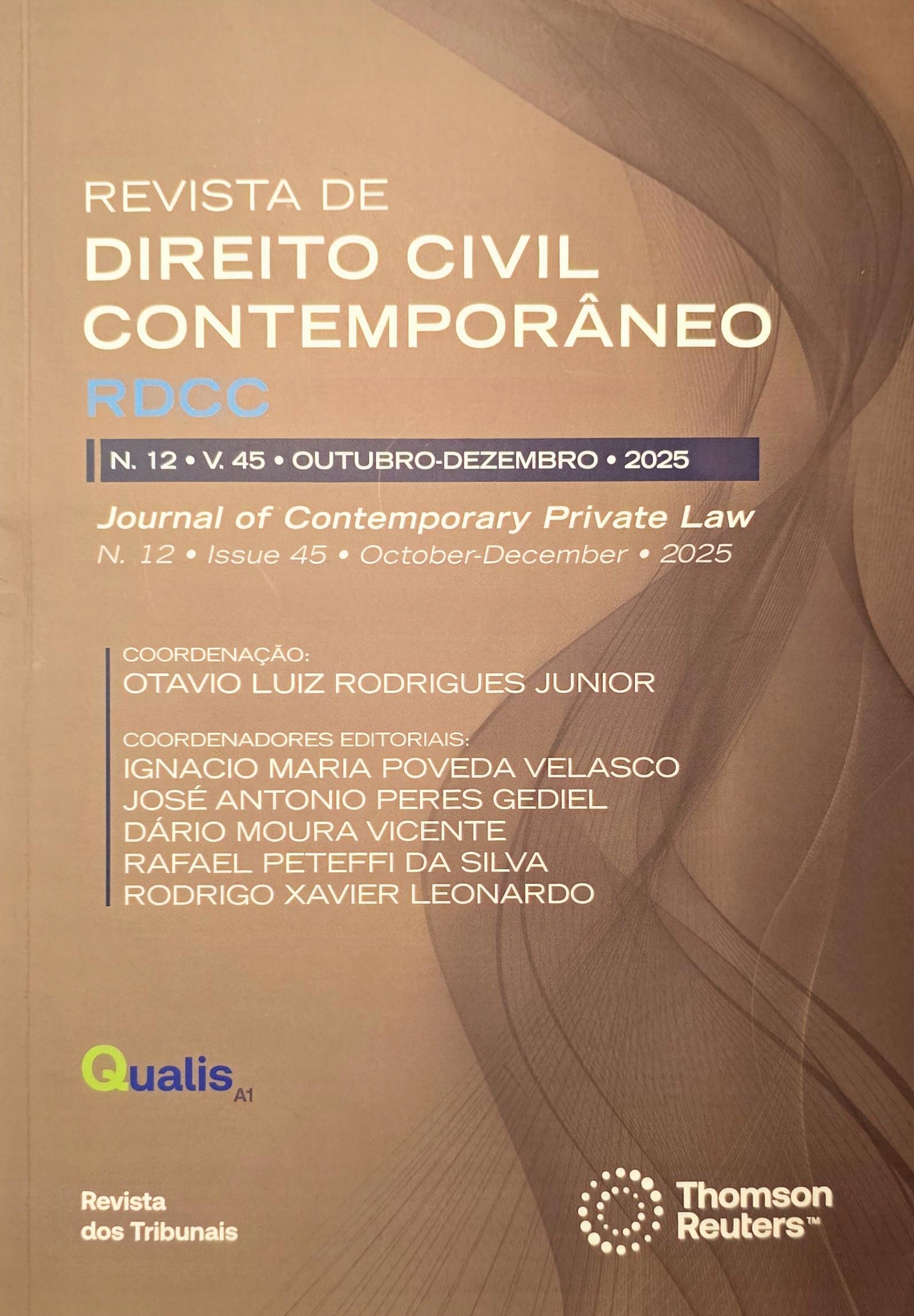
Downloads
Publicado
Como Citar
Edição
Seção
Licença
A política de direitos autorais é informada nas Normas de Publicação para autores de colaboração autoral inédita e é aqui resumida: (a) o autor cede os direitos autorais à RDCC e seus editores; (b) a remuneração do autor consiste no recebimento de um exemplar da RDCC, no qual sua contribuição foi publicada. Os textos publicados podem ser utilizados.